Custom Drone Lithium Battery Wiring Harnesses: Complete Guide
Custom Drone Lithium Battery Wiring Harnesses: The Ultimate Engineering Guide
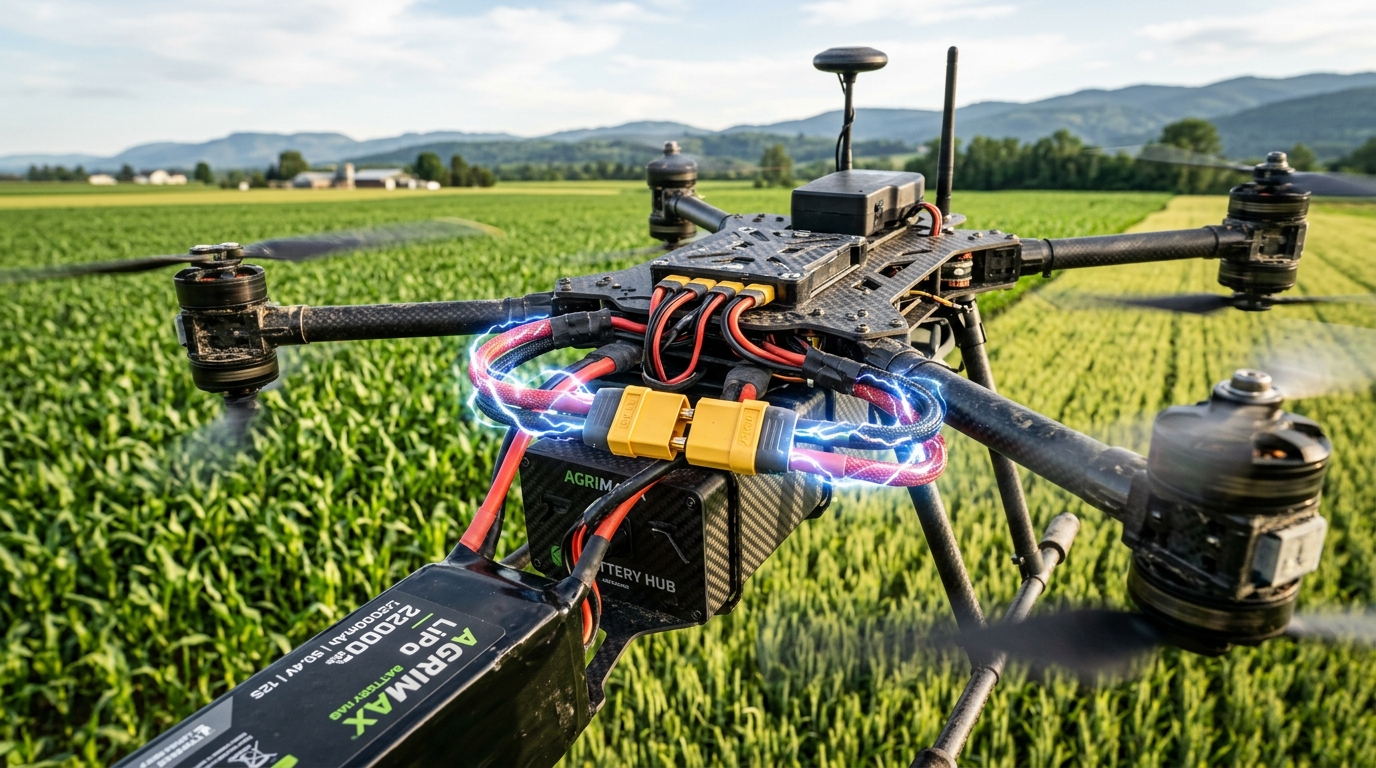
In the rapidly evolving world of Unmanned Aerial Vehicles (UAVs), a drone battery harness is far more than just a simple connection cable. It is the central "lifeline" of the aircraft, directly dictating flight safety, power transmission efficiency, and the overall reliability of the equipment. Whether you are engineering a nimble FPV racing drone or designing a heavy-lift agricultural quadcopter, selecting the right wiring harness architecture is critical to preventing voltage drops, thermal runaways, and catastrophic in-flight failures.
This comprehensive guide explores the engineering principles, connector specifications, and functional classifications of UAV lithium battery harnesses, providing vital insights for drone hardware product managers, R&D engineers, and procurement specialists.
The Core Function: How Drone Battery Harnesses Work
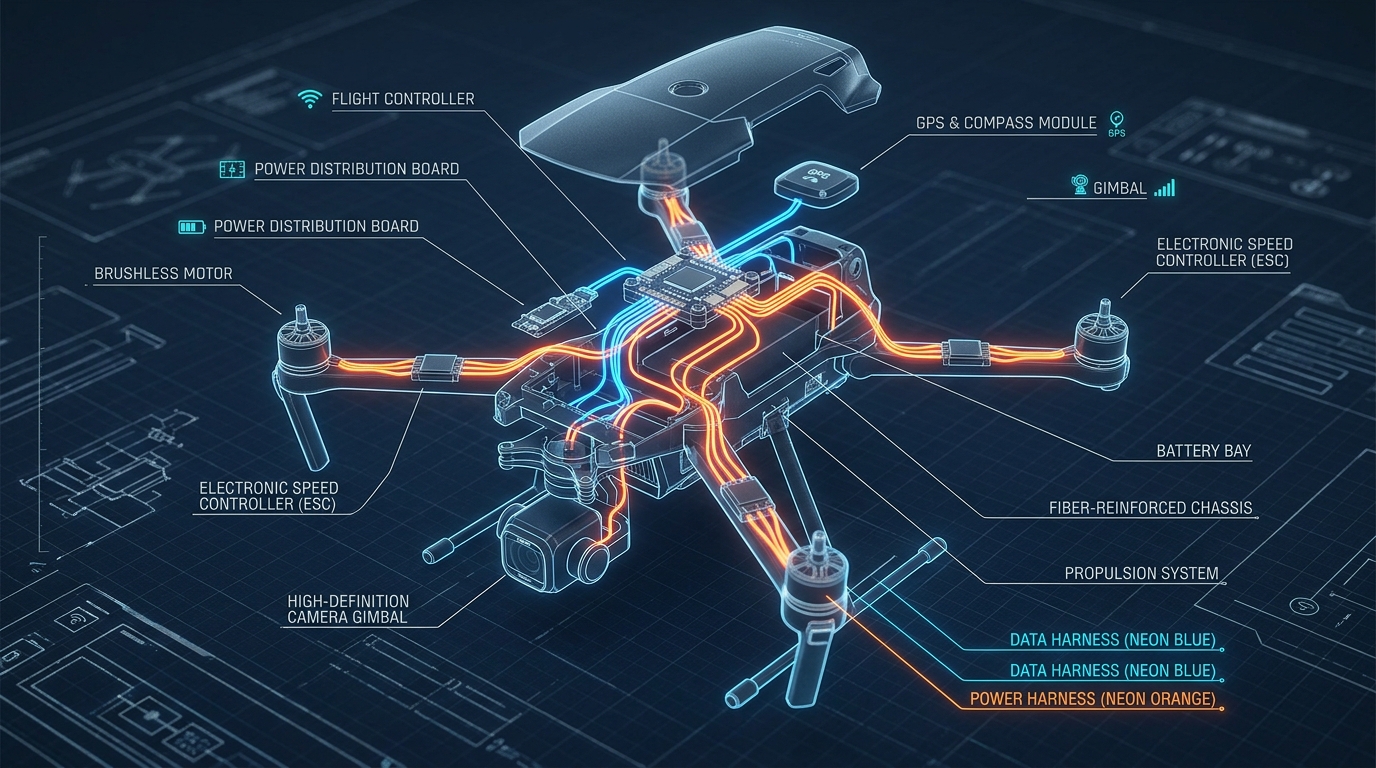
At its core, a UAV lithium battery connector and its accompanying wiring system serve as the primary conduit between the high-density power source (LiPo/Li-ion packs), the Electronic Speed Controllers (ESCs), and the Flight Controller (FC).
During high-speed maneuvers or heavy payload lifting, the propulsion system demands massive surges of electrical current. A precisely engineered power cable minimizes electrical resistance, ensuring that maximum power is delivered to the motors without generating excess heat. Furthermore, modern intelligent drones rely heavily on Smart Battery Management Systems (BMS), where secondary wiring circuits are required to transmit real-time data—such as cell voltage, temperature, and battery serial numbers—back to the flight controller to ensure operational safety.
Classification by Mainstream Connector Type
Selecting the right connector is paramount to handling specific peak current (C-rate) demands and preventing electrical arcing. Below are the industry-standard connectors utilized in custom drone manufacturing.
1. The XT Series (XT30 / XT60 / XT90)
The XT series remains the gold standard in the consumer and commercial drone market.
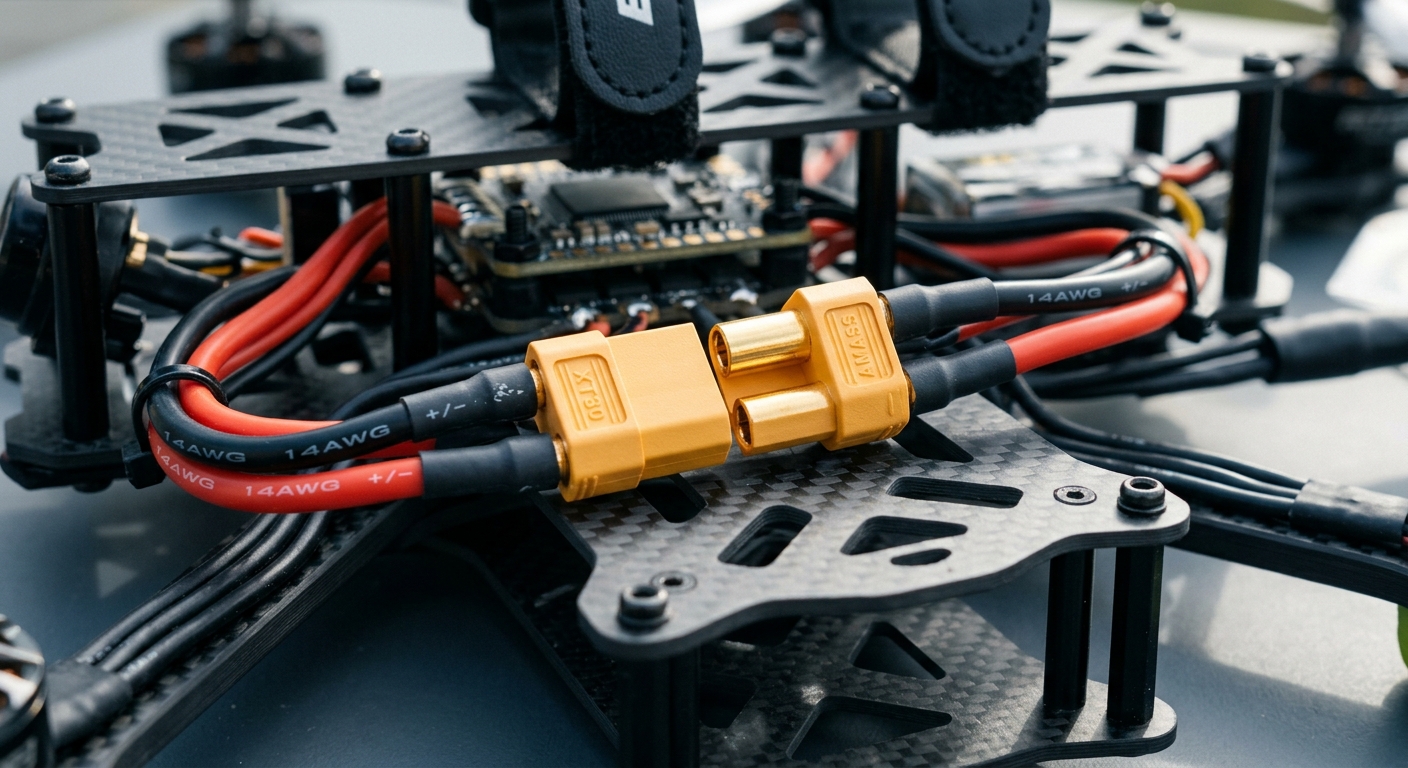
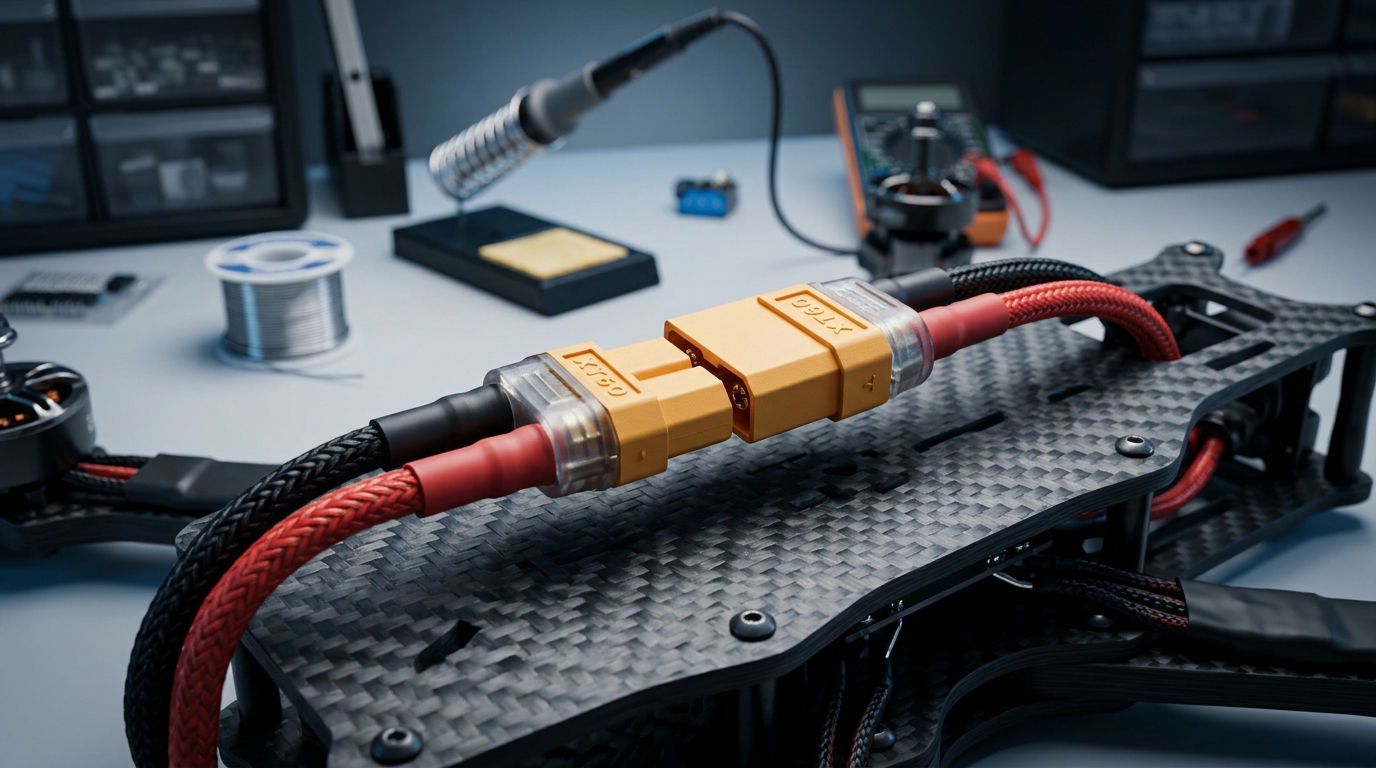
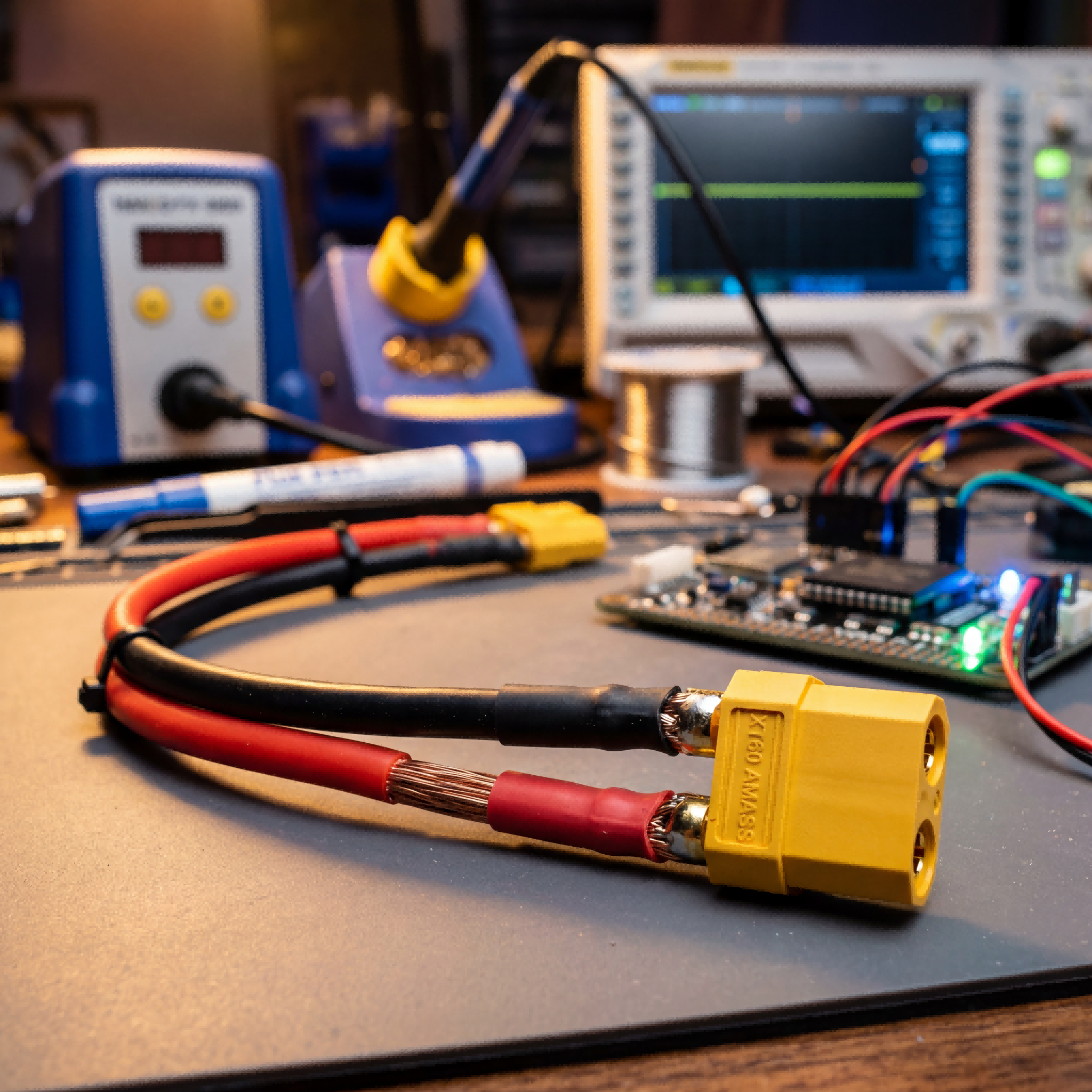
- XT30 & XT60: Designed for steady currents up to 30A and 60A respectively, making them the default choice for lightweight cinematography drones and FPV systems.
- XT90 & XT90-S: Capable of handling 90A continuous current. The XT90-S variant features a built-in resistor for anti-spark protection, which is crucial when plugging in high-voltage (6S-12S) battery packs, protecting the ESC capacitors from voltage spikes.
2. The EC Series (EC2 to EC8)
EC connectors feature gold-plated bullet contacts securely housed in a blue polymer casing. Ranging from the compact EC2 up to the massive EC8, these connectors are engineered for minimal contact resistance. The EC8, in particular, can effortlessly handle peak currents exceeding 100A, making it highly suitable for large-scale aerial platforms.
3. T-Plug (Deans Style)
Known for their compact footprint and low electrical resistance, T-Plugs utilize flat spring-loaded contacts. While largely replaced by the XT series in newer consumer models, they are still highly prevalent in custom DIY drone builds, legacy RC systems, and specific fixed-wing UAVs.
4. QS Anti-Spark Series (Heavy-Duty Industrial)
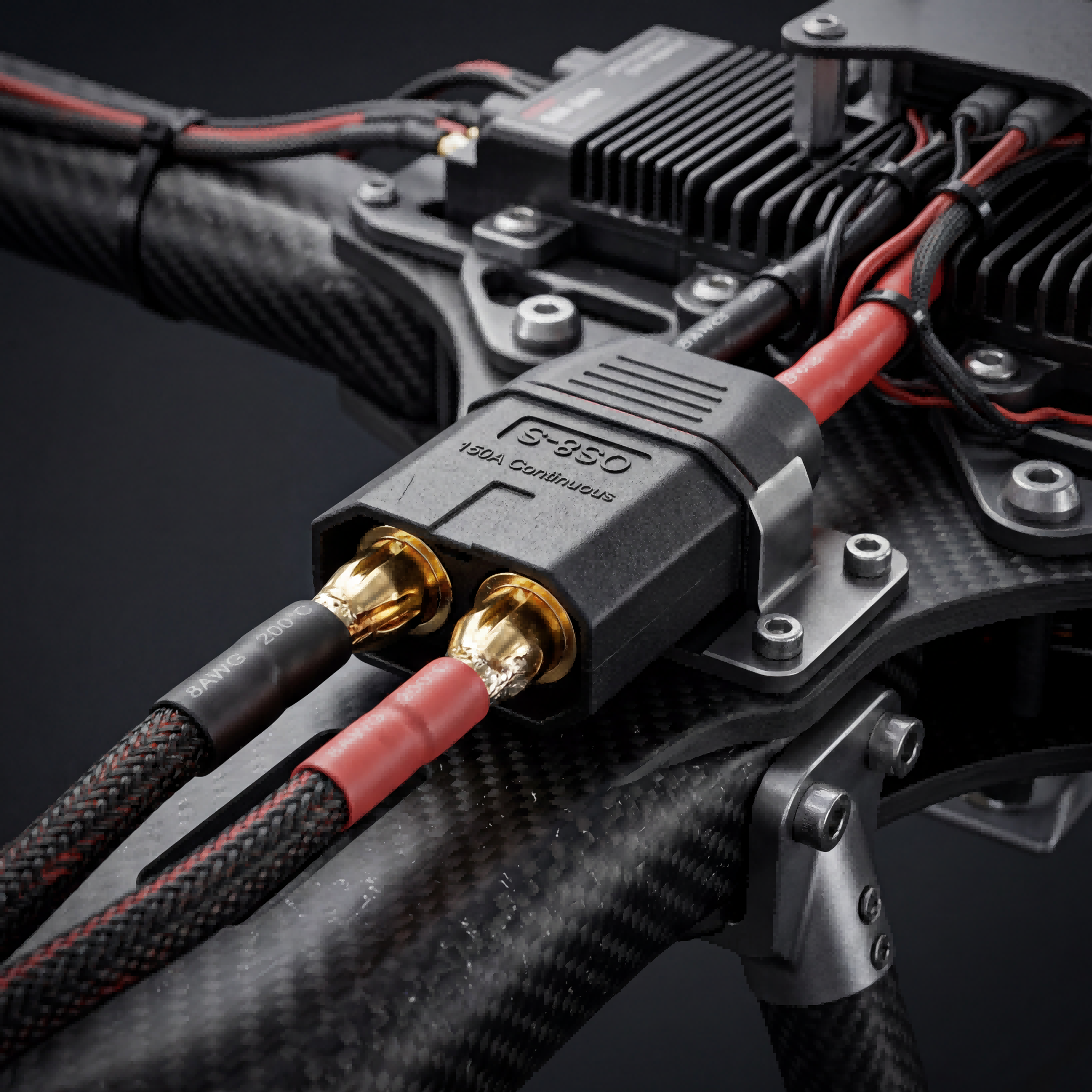
For heavy-lift agricultural and industrial drones, standard connectors fall short. The QS8-S 130A anti-spark connector is an engineering marvel designed specifically for ultra-high current applications. With thick gold-plated bullet pins and an advanced anti-arcing mechanism, the QS8-S guarantees a safe connection even under 12S-14S (50V+) environments, eliminating the loud, dangerous sparks that degrade terminal contacts over time.
5. Specialized High-Power Connectors (AS150U, XT150, PC7TB)
For specialized smart battery architectures and massive industrial drones, connectors like the AS150U and PC7TB integrate both high-current power pins and lower-current data signal pins within a single robust housing. This unified design allows both power delivery and BMS communication to occur simultaneously through one secure plug.
Classification by Functional Purpose
A professional custom drone wiring harness manufacturer categorizes cable assemblies based on their specific role within the drone's electrical architecture.
Main Power Supply Harnesses
These cables bear the brunt of the electrical load. They are typically constructed using 8-22AWG ultra-flexible silicone wire. The high-strand-count tinned copper core ensures maximum conductivity and flexibility, while the 200°C-rated silicone insulation protects against extreme operational temperatures and physical abrasion.
Balance Charging & Sampling Harnesses
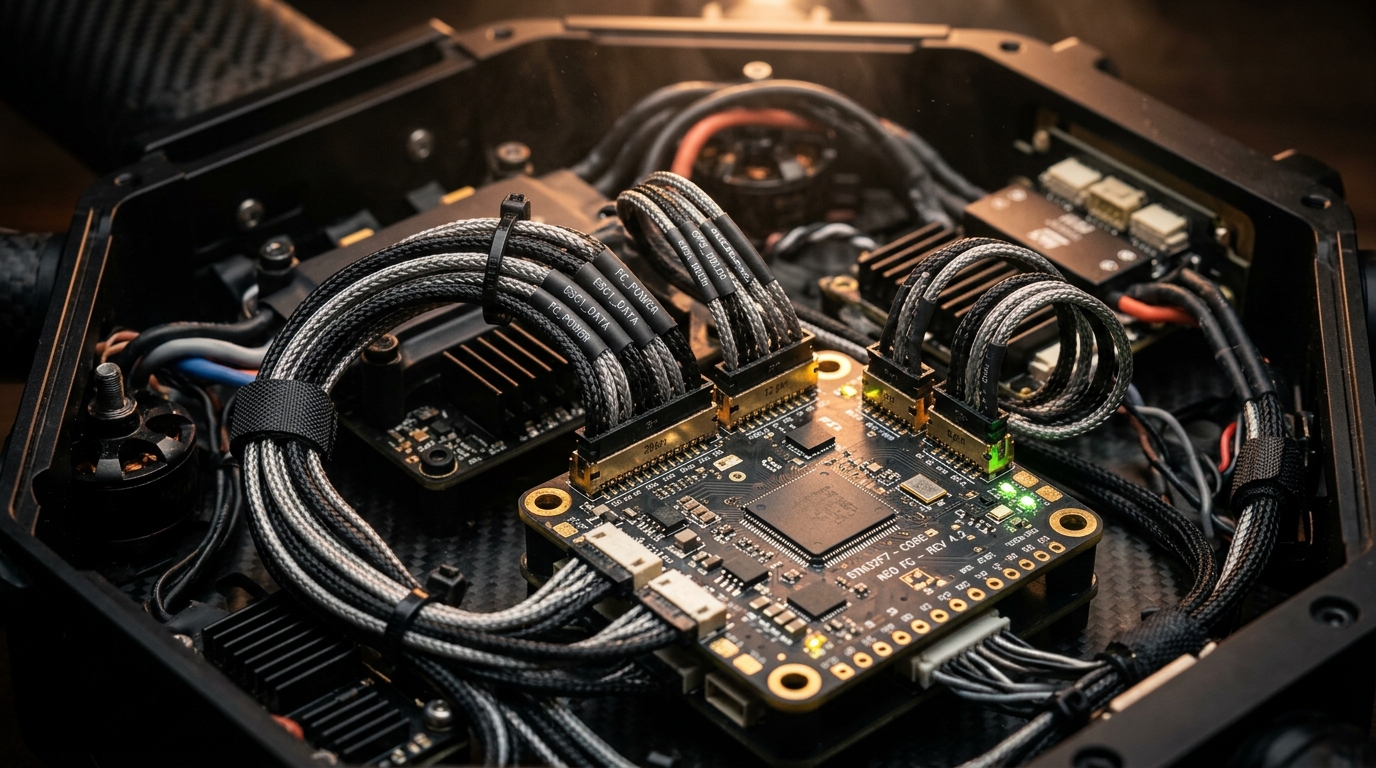
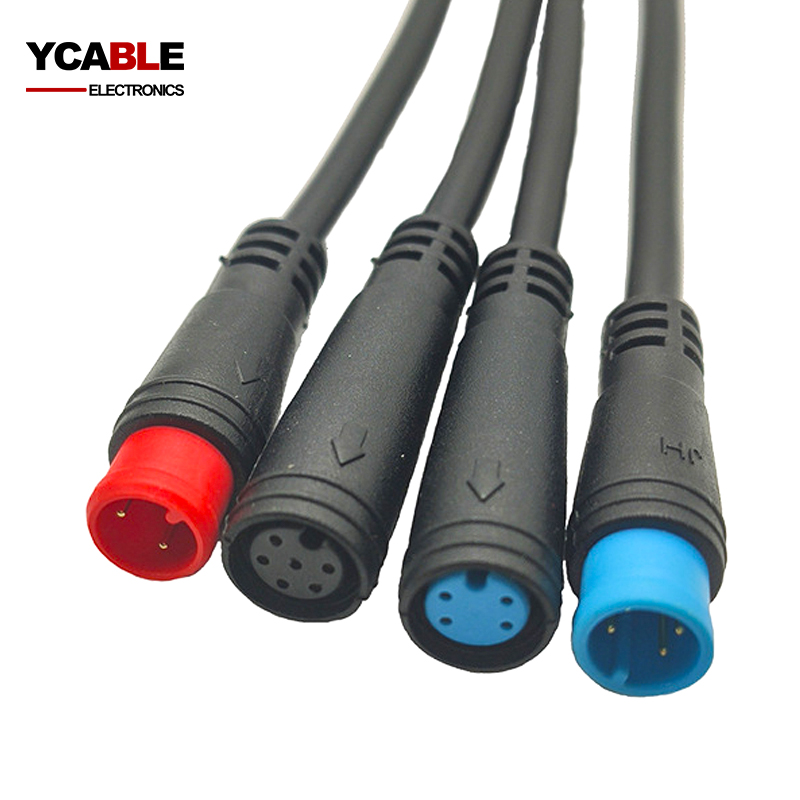
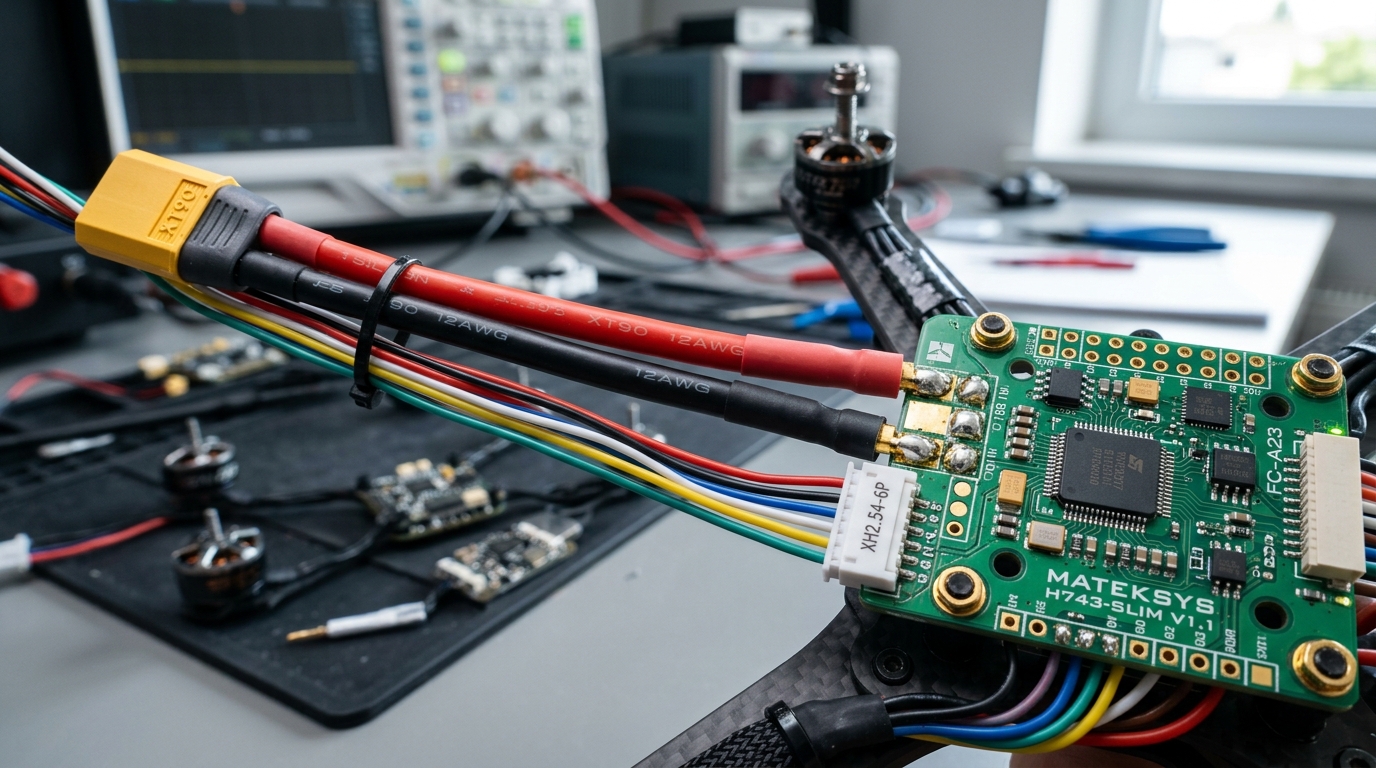
To maintain the health of multi-cell LiPo packs, XH2.54 multi-pin connectors are utilized. These small, intricate harnesses connect to each individual cell within the battery, allowing the charger or onboard BMS to monitor cell consistency, balance voltages during charging, and prevent dangerous overcharging or deep discharging scenarios.
Composite Integrated Smart Harnesses
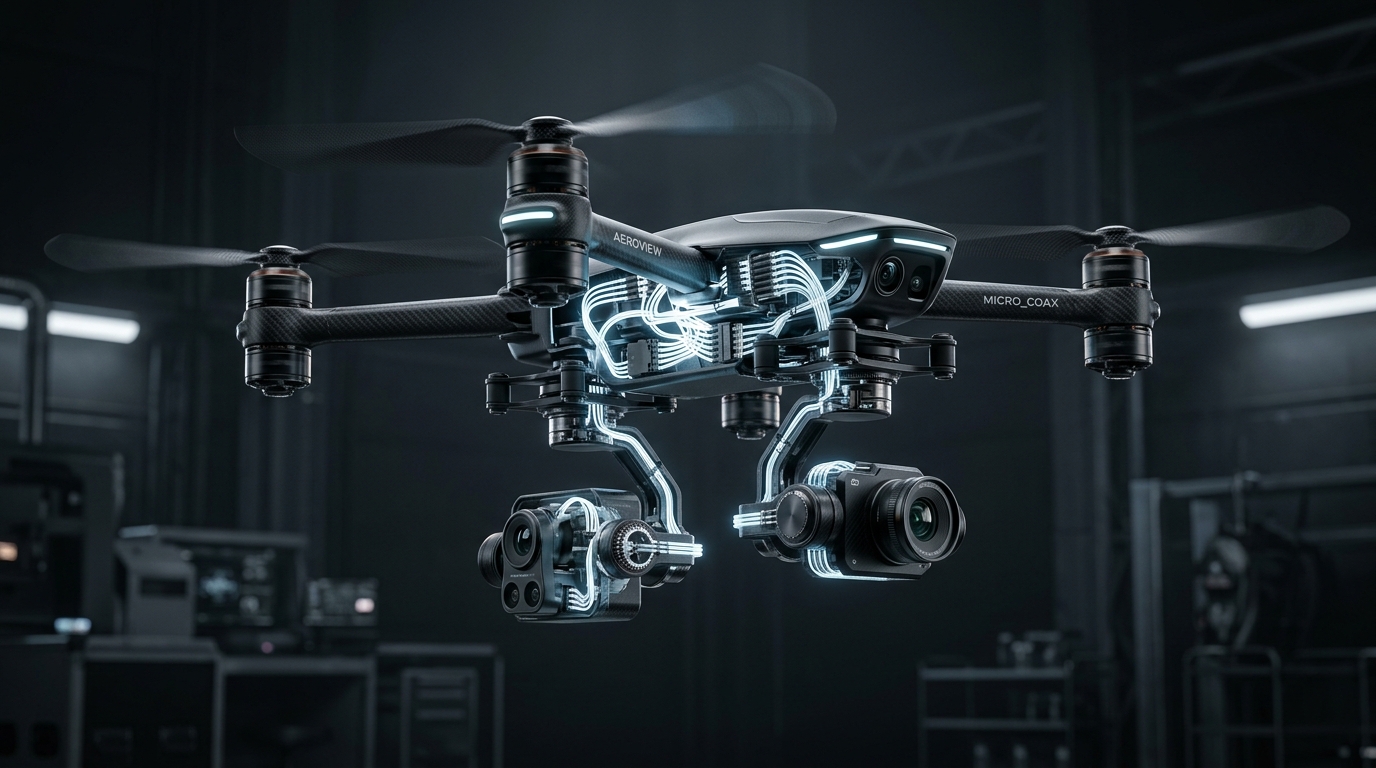
Modern UAVs demand intelligent power solutions. Composite harnesses integrate the heavy-duty power lines with delicate data communication wires. This allows the battery to transmit vital telemetry—such as internal temperature, voltage sag, and cycle count—directly to the flight controller, enabling accurate "Return to Home" (RTH) calculations.
Extension & Adapter Harnesses
Flexibility in battery mounting often necessitates custom lengths. Solutions like the XT60 male-to-female extension cable or cross-type adapters (e.g., XT90 to EC5) allow engineers to route power through complex drone frames or adapt different battery standards to a specific ESC without soldering.
Drone Wire Harness Selection by Application Scenario
- FPV Racing & Toy Drones: Focus on weight reduction. Typically utilize XT30 or T-Plugs paired with 18-22AWG silicone wires to maximize thrust-to-weight ratios.
- Consumer Photography Drones: Demand extreme reliability and flexibility. Standardized on XT60 connectors handling 30-60A loads, ensuring stable power delivery for gimbals and image processing boards.
- Heavy-Payload Agricultural Drones (Crop Dusters): Require extreme durability and chemical resistance. Rely heavily on QS8-S 130A, XT90, or EC8 connectors paired with 8-10AWG wires, capable of enduring the >90A high C-rate demands of carrying 20kg+ liquid payloads.
- Industrial & Specialized Inspection UAVs: Operate in high electromagnetic interference (EMI) environments. Require shielded custom harnesses to prevent power lines from interfering with sensitive LiDAR, thermal cameras, and GPS modules.
Technical Specifications & Engineering Selection Guide
To assist hardware engineers and B2B procurement managers, we have compiled a structural reference matrix mapping Wire Gauge (AWG) to appropriate connectors and operational thresholds.
| Wire Spec (AWG) | Recommended Connector Type | Continuous Current (A) | Peak Current (A) | Insulation Material | Typical UAV Application Scenario |
|---|---|---|---|---|---|
| 8 AWG | QS8-S 130A, AS150U, EC8 | 130A - 150A | > 200A | 200°C Extra-Soft Silicone | Heavy-Payload Agricultural, Cargo Drones |
| 10 AWG | XT90, XT90-S, EC5 | 90A | 120A | 200°C Extra-Soft Silicone | Large Hexacopters, Industrial Inspection |
| 12 AWG | XT60, EC3 | 60A | 90A | 200°C Extra-Soft Silicone | Cinematography Drones, Large Fixed-Wing |
| 14 AWG | XT60, T-Plug | 40A | 60A | 200°C Extra-Soft Silicone | Medium Quadcopters, Advanced FPV |
| 18 AWG | XT30, EC2 | 20A | 30A | 200°C Extra-Soft Silicone | Micro FPV, Toy Drones, Sub-250g Models |
| 22-24 AWG | XH2.54 Multi-pin, JST | 2A - 5A | 10A | 200°C Extra-Soft Silicone | BMS Balance Charging, Data Transmission |
(Note: Actual current carrying capacity depends on wire length, ambient temperature, and airflow cooling within the drone chassis.)
Your Trusted Custom Drone Wiring Harness Manufacturer
When the safety of a $10,000 industrial drone relies on a single power connection, you cannot afford to compromise on quality. As an industry-leading manufacturer with profound expertise in industrial electronics, we provide end-to-end custom wiring solutions tailored to your exacting aerodynamic and electrical specifications.
Why Choose Our Manufacturing Capabilities?
- ISO9001 Certified Quality Management: Every single harness undergoes rigorous testing, including pull-force tests, contact resistance checks, and high-voltage insulation tests, ensuring zero-defect delivery.
- Professional Engineering & Design Team: We don't just build to print; we optimize. Our engineers can assist with schematic reviews, EMI shielding designs, and optimal AWG selection for your specific UAV architecture.
- Complete OEM/ODM Customization: From complex composite smart harnesses to specialized XT60 male-to-female adapter lines, we customize cable lengths, connector combinations, and protective braiding.
- Low MOQ & Small Batch Production Support: We understand the iterative nature of UAV hardware R&D. We proudly support low Minimum Order Quantities (MOQ) to help startups and engineering teams seamlessly transition from prototyping to mass production.
Ready to elevate your drone's power reliability? Do not let inferior wiring ground your innovations. Contact our engineering sales team today to submit your Request for Information (RFI) or Request for Quote (RFQ). Let us build the ultimate custom power lifeline for your next-generation UAV fleet.