The Ultimate Guide to Teflon Wire Harnesses for Industrial 3D Printer Hotends
The Ultimate Guide to Teflon Wire Harnesses for Industrial 3D Printer Hotends
In the rapidly evolving landscape of additive manufacturing, industrial 3D printers are pushed to their absolute limits. Extruding advanced engineering polymers like Polycarbonate (PC), Nylon (PA), and PEEK requires sustained extrusion temperatures far exceeding those of consumer-grade machines. At the heart of this extreme environment is the hotend, where reliability is not just an option—it is a strict engineering requirement. The secret to maintaining stability and safety in this high-heat zone lies in a critical, often overlooked component: the Teflon wire harness.
For procurement managers and hardware engineers looking to build fail-proof extrusion systems, understanding the specifications of heater cartridge wiring and thermistor harnesses is paramount. In this guide, we dive deep into the technical necessity of PTFE/FEP-insulated wires and how choosing the right custom wire harness manufacturer can eliminate thermal risks and accelerate your product’s time-to-market.
The 200°C–300°C Challenge: Why Industrial 3D Printers Demand PTFE/FEP Wiring
Industrial extrusion systems operate in a continuous crucible of heat, typically ranging from 200℃ to 300℃. Within the dynamic movement of the print head, the wiring is subjected not only to extreme ambient temperatures but also to constant mechanical flexing and friction. Using standard wire insulation in these conditions is a guaranteed recipe for catastrophic failure.
PVC/Silicone vs. Teflon (PTFE/FEP): A Critical Comparison
To understand why PTFE insulated cables are non-negotiable for 3D printer hotends, we must compare them against conventional materials:
- Standard PVC: Melts and degrades at around 105℃. Exposing PVC to hotend temperatures will cause immediate insulation failure, leading to fatal short circuits.
- Silicone Insulation: While silicone can handle up to 200℃, it becomes remarkably soft and fragile at high temperatures. Under the continuous dynamic movement of a 3D printer extruder, silicone jackets easily tear or chafe against the drag chain.
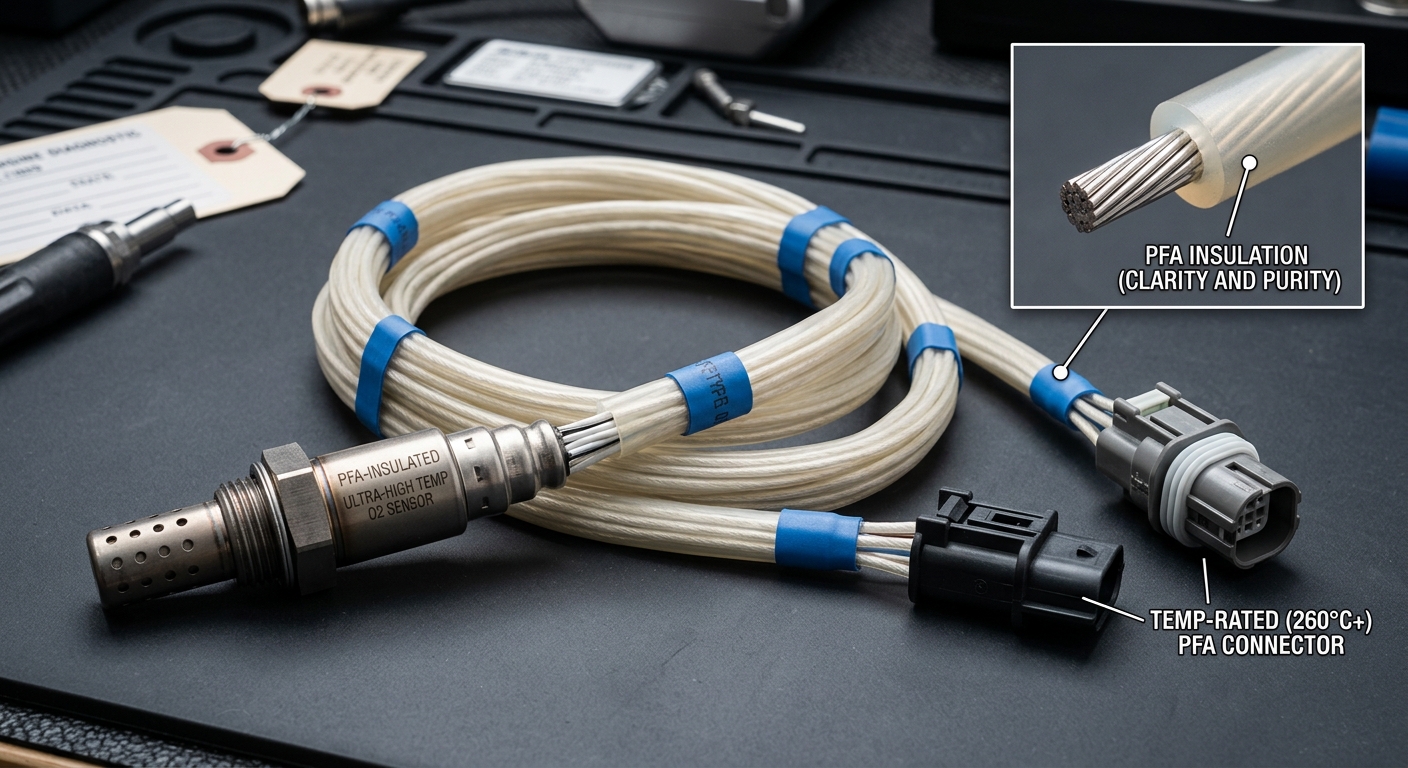
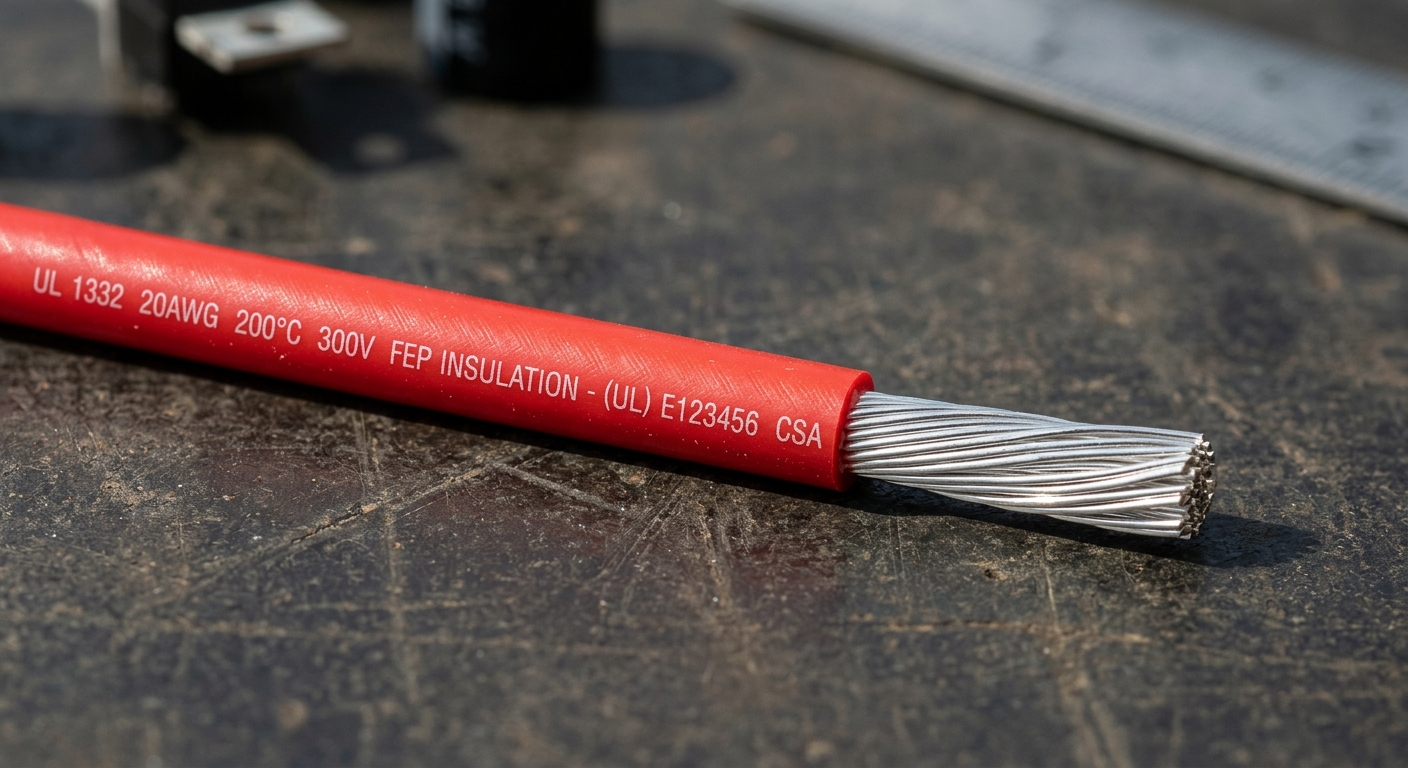
- Teflon (PTFE): Polytetrafluoroethylene (PTFE) is the gold standard. It offers a continuous operating temperature of up to 260°C and can withstand short-term spikes well over 300°C. Furthermore, Teflon possesses an incredibly low coefficient of friction and high mechanical toughness, meaning it will not degrade under constant print head movement.
For industrial applications, adopting a 100% Teflon wire harness is the only way to ensure continuous, maintenance-free operation.
Decoding Hotend Wiring: Heater Cartridge vs. Thermistor Harnesses
A high-performance hotend relies on a delicate balance of extreme power delivery and hyper-sensitive data transmission. These two distinct tasks require specific wire harness engineering.
Heater Cartridge Wire Harnesses: Powering the Melt Zone
The heater cartridge is the muscle of the hotend. A typical industrial 24V heater cartridge draws significant current to maintain high temperatures (often 40W, 50W, or even 70W). The heater cartridge wire must be engineered to prevent voltage drops and withstand intense thermal radiation.
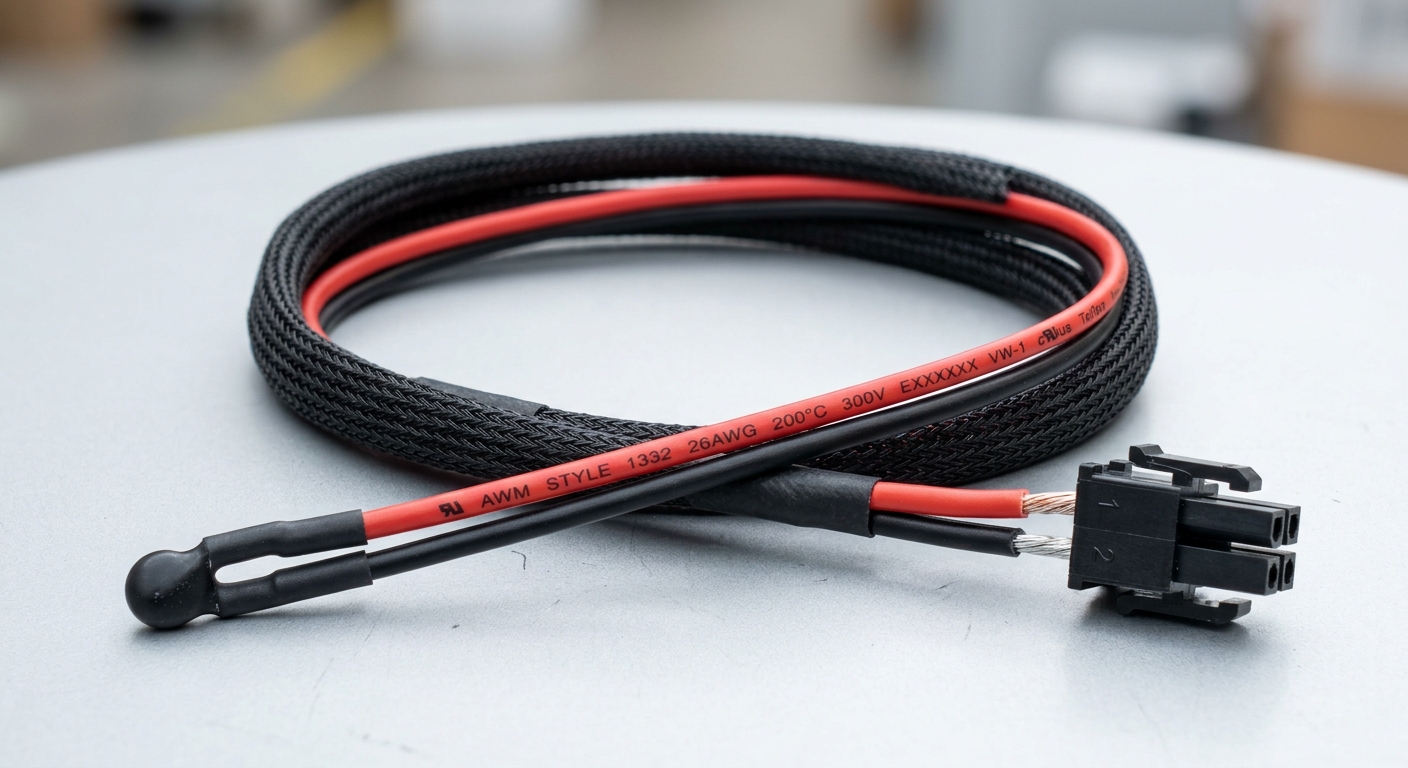
- Wire Gauge (AWG): We typically utilize 20 AWG to 22 AWG multi-stranded tinned copper or nickel-plated copper wire. This ensures optimal flexibility while safely carrying high currents without self-heating.
- Insulation Thickness: Heavy-wall PTFE/FEP extrusion is applied to provide robust dielectric strength, ensuring that the heating element's high power does not arc to the aluminum heater block.
Thermistor Wire Harnesses: Ensuring Precision Temperature Sensing
The thermistor (such as an NTC 100K or PT1000) is the brain of the hotend, sending micro-voltage resistance readings back to the mainboard. The thermistor wiring is highly susceptible to electromagnetic interference (EMI) and mechanical stress.
- Wire Gauge (AWG): Due to the low current, 24 AWG to 26 AWG is standard. However, the internal strands must be highly flexible to prevent internal fatigue fractures after thousands of hours of printing.
- Signal Integrity: Any micro-break in the thermistor wire can cause resistance spikes. A premium Teflon thermistor harness maintains precise signal integrity, ensuring the motherboard always reads the exact temperature of the melt zone.
Preventing Thermal Runaway: The Role of Professional Wire Harness Assembly
In the 3D printing industry, "thermal runaway" is a worst-case scenario. It occurs when a broken thermistor wire sends a false "cold" reading to the motherboard, causing the system to pump continuous maximum power to the heater cartridge until the hotend melts or catches fire.
As a professional wire harness manufacturer, we understand that exceptional raw materials must be paired with flawless assembly. We utilize automated micro-crimping technology to attach JST, Molex, or customized connectors. Our strain-relief engineering ensures that the mechanical stress of the moving extruder is never transferred to the delicate crimp joints, effectively eliminating the mechanical failures that lead to thermal runaway.
Your Trusted Custom Wire Harness Manufacturer for 3D Printing
Sourcing off-the-shelf cables is a gamble that industrial 3D printer OEMs cannot afford to take. You need a dedicated manufacturing partner capable of delivering end-to-end extruder cable management solutions.
Why Partner with Us?
- Dedicated Engineering Support (Feature): We offer an in-house team of electrical engineers who understand the unique kinematics and thermal dynamics of 3D printers.
- 100% Customization (Advantage): From specific cable lengths and custom crimping connectors (e.g., Micro-Fit) to fiberglass braided sleeving over PTFE/FEP, we build precisely to your BOM.
- Accelerated Time-to-Market (Benefit): With our rapid prototyping capabilities and rigorous pre-shipment testing (including continuity and high-pot testing), we help you deploy your new printer models faster and with zero warranty claims related to wiring failures.
- Proven Reliability (Evidence): Our wire harnesses are trusted by leading industrial automation and additive manufacturing brands worldwide, strictly adhering to ISO quality control standards.
Don't let inferior wiring compromise your cutting-edge 3D printer design.
Ready to upgrade your extrusion system's reliability? Contact our engineering team today for a custom Teflon wire harness solution tailored to your specific heater cartridge and thermistor requirements. Let us provide you with free engineering samples and a competitive bulk quote within 24 hours!